
February 5 News Roundup
- cstewart437
- 4 hours ago
- 5 min read
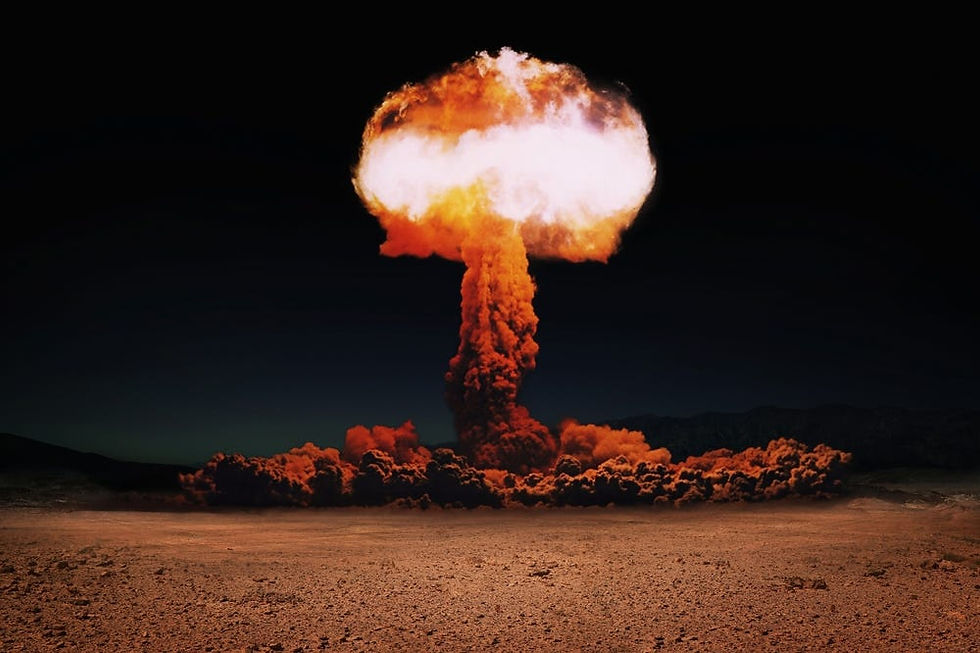
Three stories from around the world. Somehow, all of them include the cheerful topic of nuclear weapons. Enjoy!
As Nashville begins to thaw more following the chaos of Winter Storm Fern, I thought I would use the opportunity this week to briefly highlight some of the major stories occurring around the world. Of course, geopolitical troublemakers China, Russia, and Iran have all found their way into the spotlight. Here is an update on the latest activities of all three, in ascending order of their threat potential.
Iran
A recent report from Reuters published on Monday has offered a candid view of just how vulnerable the clerical Iranian regime is right now. Having recently, and brutally, defeated mass popular unrest, Tehran is also stuck under a Sword of Damocles in the form of potential military strikes by the United States. Reportedly, embattled Supreme Leader Ali Khamenei, publicly defiant but likely privately concerned, was informed by top officials that not only are the suffering Iranian people shedding their fear of a violent crackdown, but that potential US strikes would lead to another round of protests and perhaps, ultimately, the complete collapse of the system. That is why, especially following President Donald Trump’s cryptic threat of the consequences of a failure of diplomacy, Tehran is desperately seeking a way out. This determination especially applies regarding Iran’s controversial nuclear program.
Thanks to frantic mediation efforts by other regional powers, it appears that nuclear diplomacy between the two arch rivals, derailed by Operation Midnight Hammer, may be back on track. Since Iran would have no strategic alternative but to retaliate after a military strike, these powers, including Qatar, Saudi Arabia, Israel, and Turkey, all have a vested interest in achieving a diplomatic settlement. While such a settlement would drastically reduce both the risk of war and of Iran obtaining the ultimate weapon, it would be a disappointment to the Iranian people, as it would also ensure a degree of security for the rotten regime in Tehran. Decisions, Decisions.
Russia
Continuing with the comforting topic of nuclear weapons, why not discuss the country with the world’s largest stash of them? Since the zombie negotiations between Moscow and Ukraine are continuing to go nowhere, a more interesting development regarding Russia is not a potential future treaty, but a past treaty on the brink of termination: the New START treaty. Signed in 2010 by American and Russian Presidents Obama and Dmitry Medvedev and ratified by the United States Senate the following year, New START reduced both the United States and Russia to 1550 deployed strategic (code word for nuclear) warheads and 1500 deployed missiles, bombers, and missile launchers. Since then, of course, relationships between the two superpowers deteriorated sharply over Russian interventions in Ukraine. Now, the agreement is due to expire on Thursday, dismantling the last major vestige of the global arms control regime.
While President Trump has expressed interest in New START’s extension, and has even called for China, whose own arsenal has mushroomed in recent years, to sign on as well, it appears that unlike the Iranian nuclear concern, no serious measures have been undertaken by the administration to see out these wishes. According to Arms Control Association executive director Daryl Kimball, the president “seems to have the right instinct on this issue but has thus far failed to follow through with a coherent strategy.” In my opinion, an agreement could easily be reached, especially as Moscow maintains a vital interest in maintaining global nuclear bipolarity. Even former signatory turned-belligerent hawk Medvedev supports a New START extension. Unfortunately, it has slipped through the cracks of Trump’s famously top-down managerial style as the president and a small clique of aides micromanage American foreign policy— leaving critical fields like arms control short-staffed.
As the global Big Three (Sorry, Europe, India, and Japan) move to close the chapter in human history of arms control, not only do they appear to be moving full steam ahead, other nations worried by the trio’s unpredictability may too pursue options once considered unthinkable— a nuclear arsenal of their own.
Major Update: it appears that the Trump Administration and Russia have agreed to a partial and unofficial extension, following delays due to concerns about China. More to come in the following months and years on this matter.
China
It wasn’t so long ago that this author highlighted a major purge by Chinese president Xi Jinping against generals of the People’s Liberation Army (PLA.) Well, it turns out Xi has some unfinished business, and his purges are far from over. Last month, Zhang Youxia, Vice Chairman of the Central Military Commission and a close friend and colleague of Xi for decades was arrested for corruption and alleged “serious breaches of discipline.” What makes this arrest so shocking is that Zhang, according to China expert Marc Lanteigne, was Xi’s “right-hand man… responsible for supervising and implementing the modernization project of the Chinese army.” Officially, Zhang is a victim of Xi’s notorious long-running anti-corruption campaign, a legal blitzkrieg dooming literally millions of Chinese Communist Party officials to public humiliation, prison, or worse. While certain rumors have alleged that Zhang was a traitor selling nuclear (there’s that word again!) secrets to the United States and plotting a military coup, the real explanation for Zhang’s fall is likely far less dramatic, but no less concerning.
As with all matters and events in the enigmatic corridors of Zhongnanhai, diagnosing the downfall of Zhang Youxia is challenging even for the most experienced China experts. But, there are a few clues. The most obvious, of course, is the anti-corruption campaign. While corruption within the PLA is a long-running concern, such a purge likely reflects one of Xi Jinping’s core goals: remaining China’s de facto emperor for life. As in any dictatorship, anti-corruption purges become little more than a smokescreen for eliminating rivals within the system. With the PLA in a state of “disarray,” according to Lyle Morris from the Asia Society Policy Institute, it’s obvious that any successor to Zhang will be a loyal lieutenant to Xi and Xi alone. If even a close friend (literally from childhood) and hero from China’s last major conflict (fought against Vietnam in 1979) faces Xi’s guillotine, then no one in Beijing is safe. Not a fun time to be a Chinese Communist Party boss right now.
The other concern is, as in every conversation where Xi Jinping’s name is raised, of course, Taiwan, specifically Xi’s overtly expressed interest in reclaiming it one day. According to multiple sources, Xi was frustrated with Zhang’s cautious, more deliberative approach to Taiwan contingency preparations that contrasted with Xi’s hardline demands. Since Xi has made reunification not merely a policy goal but an integral part of his domestic legitimacy, any action seen as undermining this messianic pursuit is in his mind nothing less than pure treachery. Again, and I have said this before and will continue to do so for the foreseeable future, Xi is not likely to invade tomorrow, and he certainly prefers to coerce both Taiwan and others rather than risk everything by starting a shooting war. Still, this purge in Beijing is a strong indication that Xi Jinping is a man who will never accept no for an answer, even from his closest friends.


Comments