
Nixonmaxxing

A Gen Z phenomenon rehabilitates a once disgraced president whose mistakes ought not overshadow his intellect
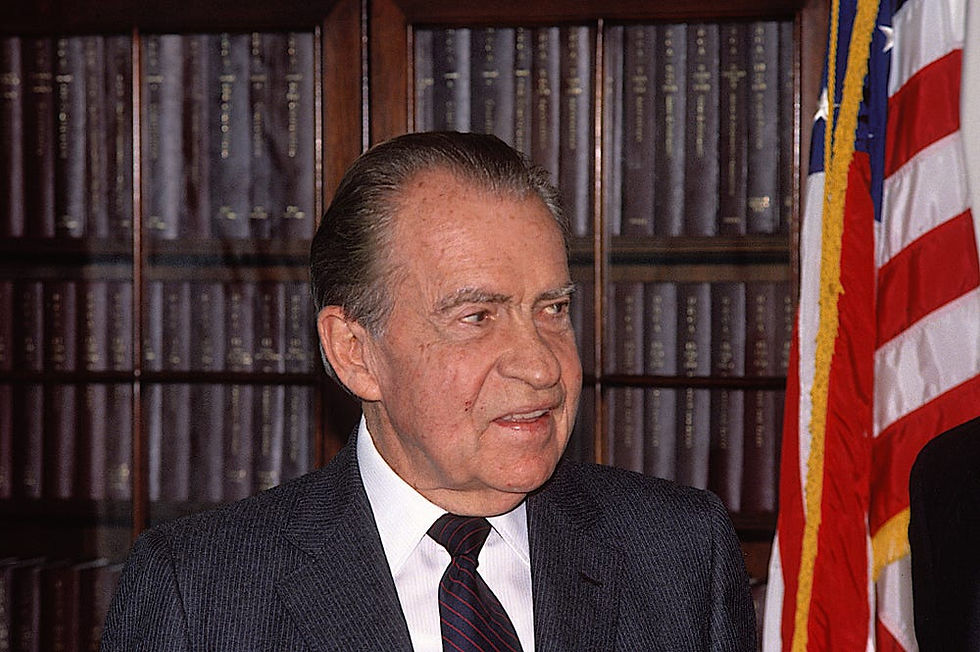
Of all the many injustices and outrages that occur in our world, there are few, if any, that frustrate me more than revisionist history. As a writer dedicated to informing my readers of the most accurate information I can access, I consider the world of misinformation and rumors to be my most formidable enemy. I may have even called you out personally if I spot such misinformation. For a man who prefers to avoid confrontation and not hurt anyone’s feelings, such a step is most, shall we say, audacious. Even worse than a TikTok algorithm run amok, however, are the effects of decades of a top-down smear campaign against a now-deceased American president whose accomplishments, after years of mockery, are finally receiving the praise and recognition they deserve.
Fifty-two years ago this month, Richard Milhous Nixon, America’s 37th president, resigned in disgrace after a two-year saga in which Republican political operatives (operating without Nixon’s foreknowledge or approval) staged a now-infamous break-in of the Democratic National Committee’s headquarters at the sprawling Watergate Hotel complex in Washington, D.C. to uncover dirt on potential opponents for Nixon’s 1972 reelection campaign. Nixon’s fatal mistake, ordering the FBI to halt its investigation of a clear example of criminal misconduct was caught on tape only six days after the break-in, was a blatant obstruction of justice. Once the “smoking gun” tape was released to the public, Richard Nixon lost all political support, even from other Republicans. As he was drowning in deep depression, heavy drinking, and self-medication, he had little alternative but to vacate the office he had spent decades working to achieve.
In an era when there were only three major news networks, Nixon had no alternative media space where he could defend himself beyond press conferences that were immediately dismissed by the Washington press corps as deceitful. However, as the many failed attempts by current president Donald Trump’s enemies to derail his political career, including three assassination attempts, have made evident, the media landscape of 2026 is not the same network that defeated Richard Nixon in 1974. Yes, there is ample misinformation and outright junk out in the grand ecosystem of cyberspace. But there also exists a space for redeeming historical figures wronged in their lifetime.
Let me introduce to you all the viral phenomenon known as Nixonmaxxing.
In social media slang, maxxing, according to Merriam-Webster, “describes the practice of optimizing a specific aspect of one’s life, often to an extreme degree.” While most maxxing trends are not worth our time here, Nixonmaxxing is exactly the clever mix of Generation Z social media habits fused with Richard Nixon’s insights about American society and international affairs our nation and world need.
Back in 2018, Jim Byron, the president of the Nixon Foundation based in the 37th president’s home state of California, began to seek out ideas to make the one-time villain of Watergate not only relevant, but cool. In one video posted on the foundation’s Instagram account in May, Nixon waves to adoring crowds and shakes the hands of his supporters young and old set to a modern-day rap soundtrack. In another video, the fictional character Don Draper from the AMC series Mad Men calls Nixon the “Abe Lincoln of California,” set to yet another rap track, this time by R&B superstar Drake. In the second video, Draper favorably juxtaposes Nixon’s humble background as the second of five sons (two of whom died young) to two hardworking parents on a California citrus farm and his naval service with John F. Kennedy’s privileged East Coast upbringing as his justification for voting for Nixon in the 1960 presidential election.
The trend has even received a shoutout from Vice President JD Vance, who, while speaking at the Richard Nixon Presidential Library in Nixon’s birthplace of Yorba Linda, California, went so far as to call himself an admirer of the 37th president, claiming that Watergate would have been a “12-hour news story” today and also compared Nixon to Donald Trump as victims of a “deep state” devoted to their political and personal ruin. Whatever one’s opinion on Donald Trump and the so-called “deep state,” there is no doubt to me that whatever Richard Nixon’s flaws, the press, along with the entire Georgetown Cocktail Circuit, (as the Washington elite bubble was known during Nixon’s era) was devoted to ruining a man whose only crime was speaking to the interests of the silent majority against the radicalism slowly seeping into elite media discourse.
Today, more than 50 years later, the world Nixon so feared has come home to roost.
In his later years, Richard Nixon labored to remove the shame of Watergate from his legacy by returning to the public eye as a sage of foreign affairs. Since his administration successfully extracted the United States from Vietnam while simultaneously beginning the process of normalizing the bilateral relationship with the People’s Republic of China, Nixon’s insights, otherwise scorned by the same DC cocktail establishment, could not simply be ignored. Only one month before his passing from a massive stroke in 1994, Nixon mailed a letter to President Bill Clinton warning that the relationship between Russia and Ukraine was “highly explosive,” and if allowed to explode, “will make Bosnia look like a PTA garden party.” Nearly 30 years before the outbreak of the deadliest European conflict since 1945, Nixon, who visited Russia four times after his presidency, was more aware than anyone of the bitterness in Russian society regarding their nation’s 1991 collapse.
Perhaps the most prophetic of all were Nixon’s comments on Mohammad Reza Pahlavi, the fallen Shah of Iran. Pahlavi, like Nixon, was a man thoroughly scorned during the 1970s due to his crackdowns on civil liberties and massive oil wealth, and much of the Western intelligentsia celebrated his 1979 downfall just as enthusiastically as they celebrated Nixon’s. Of course, little did any of these righteous liberals know that the regime that emerged after 1979 would make the shah’s repression look like community service. And Richard Nixon, who attended Pahlavi’s funeral in 1980 when the rest of the world turned the cold shoulder to a monarch who legitimately attempted to modernize and improve his nation, was, again, vindicated. In 1980, Nixon bluntly told journalist Barbara Walters that if the United States did not stand up for its friends like the shah, “we’re not going to have friends” and that the choice in Iran “was not between the shah and somebody better, but between the shah and somebody infinitely worse.”
Again, Richard Nixon had utterly obliterated the quixotic and doomed moral crusades of the Georgetown Cocktail Circuit.
Yes, we all know that Richard Nixon made one crucial mistake, a mistake for which he paid dearly. Still, he was a man who worked hard to pull himself from poverty all the way to the White House, achieved diplomatic success in Beijing and Paris, and offered an ungrateful public his prophetic intuition of foreign affairs as well as the danger of domestic radicalism. And that is why we ought to relegate Nixon’s mistake to the historical margins. While it may take a few 21st-century algorithms and the clunky phrase Nixonmaxxing to fulfill the task of informing our young people about the cruel realities of the world, it is fine by me that this historical injustice is finally being redressed.


Comments